

Can you think of anything more boring to talk about than a crawlspace? Tough to keep readers after that statement, but wait one minute. Crawlspaces are important because:
- As much as 50 percent of the air inside your home comes up from the crawl space.
- Crawlspaces, attics, and unfinished basements are the 3 most common areas to find mold in a home.
- Many Crawlspaces have HVAC ducts that can pull air from the crawlspace into your home. If the crawlspace isn't clean, neither is the air inside your home.
- Damp crawlspaces will breed termites, spiders, ants, and other insects.
- About 90% of crawlspaces we evaluate are in need of attention.
Here is the good news: Curren consults on environmental building issues, and I can explain both the DIY crawlspace management as well as hiring a company to address the crawlspace. To be objective, both DIY and professional crawlspace management can have VERY similar results; the thousands of dollars between the two rarely justifies the marginal increase professional management achieves.
Water proofing (ahem, water management) companies that do crawlspaces will not want you to read this.
Why do Crawlspaces have mold growth?
Traditionally, builders either insulated the floor above the crawlspace or left it uninsulated, while keeping wall vents open for ventilation. This approach assumed that vents would remove moisture, but in humid climates, they actually allow moist air to enter. When this air contacts cooler crawlspace surfaces, condensation forms. This process often results in drooping insulation and mold growth on exposed wood.
Crawlspaces are typically cooler and less humid than outdoor air during summer, which draws moisture inside. Humid air then condenses on cold wood and concrete surfaces, creating a persistent moisture source. This design results in a high likelihood of mold growth, with a 90% probability.
A crawlspace will, by nature, be cool in summer and less humid than outdoor air, so moisture and humidity will be drawn to the space, allowing the humid air to condense on the cold surfaces of wood and concrete in the crawlspace. This provides a continuous source of moisture in the crawl space. This type of design has a 90% chance of allowing mold to grow.
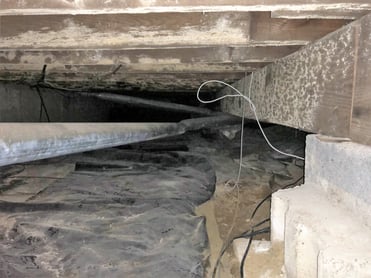
This photo shows a crawlspace that has ATTEMPTED to control moisture; there is a black poly vapor barrier on the floor. But if you look closely, you can see it doesn't cover the floor 100% (there is exposed soil). There are also open vents that you cannot see. Bottom line, the poor management of moisture is allowing mold to grow; you can see the white staining on the wood.
On a basic level, humidity is a real driver of mold growth in a crawlspace, but you can also have other sources. Physical water intrusion, gutters, plumbing leaks, as well as improper exterior management, can be contributing factors.
The historic design of a crawl space creates a perfect environment for mold. It has oxygen, it is dark, there is ample food (dirt, wood, insulation, animal waste), and as discussed, the temperature and humidity level create the perfect ecosystem for mold growth.
Crawlspace Management
Exterior of the Crawlspace
If you want to have a well-maintained crawlspace, let's start with easy to hard things you can do. On the exterior perimeter of the crawlspace, all soil should be sloped away from the foundation, allowing water to flow away, not toward the crawlspace. I would say 60% of inspections find the exterior grading in need of improvement. Next, your roof leaders (gutters to the layperson) should have 5' to 10' extensions so rainwater flows far away from the foundation. Understand that water in the soil around a foundation and even the masonry foundation will draw moisture into the crawlspace, so reducing the water around the foundations also decreases moisture in the space.
The easiest way to know if you need to do any of this is to actually go into the crawlspace when the weather is nice and again after or during a rainstorm to see if you are getting water entry. You can also walk the exterior with an umbrella when it's raining to see if water puddles near the foundation; those are the problem areas.
Interior of the Crawlspace
There are three things you need to do to reduce moisture inside the crawlspace.
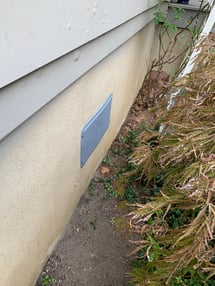
First, seal all exterior vents in the foundation; this can be performed with rigid foam board, cut to fit. Spray foam can be added along the edges to really seal the opening. When you have the can of spray foam going, seal any penetrations in the foundation where you can see sunlight entering, like for hose bibs, utilities, etc. You can also install plates on the outside of the foundation, like the photo to the left. It's best to do both, as the foam board also insulates the opening. An overlapping layer of plastic sheeting is placed on the floor of the crawlspace. Home Depot sells a 6-mil roll of poly sheeting, 20' by 100', for $127. You can use bricks to weigh down corners and along the seam. A double layer is best; the hardest part is having to cut around internal supports in the space.
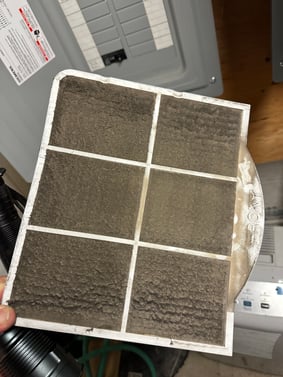
Install a dehumidifier with tubing that allows it to drain outside the crawlspace. You will need electricity and installation in the approximate center of the space is best. Every three months, you must pull out the screen and run it under water. The photo to the left is a screen the owner never knew existed. For a baseline, if you hold a clean screen up to your face, you can see through it; this one failed.
This DIY fix, excluding your labor, is approximately $1,000.00. This is with about $300 in plastic, $350 for a decent dehumidifier, and the balance for other materials. Larger spaces will cost more in materials. This assumes you have an outlet in the crawlspace to plug a dehumidifier into; otherwise, you need an electrician.
Naysayers will tell you this approach doesn't 100% air seal the space. Well, guess what, none of them do. Does every person use a dehumidifier in their basement? It runs right? collects water, and your basement has walls? a floor and a ceiling? Is it pretty sealed? But not 100% apparently.
Pro Tip: If you are going to address your crawlspace for moisture, you should also address mold that likely formed before your fixes. Mold Remediation
Mold remediation of a crawlspace will remove existing mold and future-proof the space by applying a fungistatic coating (mold inhibitor) to the wood, which is the mold's food source. Mold-resistant coatings have 10-year warranties to prevent mold growth on the surfaces where it is applied. But in practice, you will be dead before mold grows on it as UV light breaks it down which your crawlspace doesn't receive.
Professional Crawlspace Management
You just received professional advice on managing your crawlspace. But maybe you are physically unable to perform the recommended tasks. Google "crawlspace management", scroll down about 8" on the page, scrolling by all the companies that are paying for placement of their ads, and look for organic search results.
- Installing a Vapor Barrier: A thick (typically 8 to 20-mil) polyethylene liner is installed across the entire floor and up the foundation walls and piers to help minimize moisture from entering the space.
- Sealing Foundation Vents: Crawl space vents, air leaks, gaps, and cracks around plumbing and wiring penetrations are sealed to prevent unconditioned outside air and pests from entering.
- Insulation of foundation Walls: Foam board insulation is often installed on the interior foundation walls to stabilize temperatures and improve energy efficiency.
- Humidity Control: Installing a dehumidifier to remove any remaining moisture from the air and maintain optimal humidity levels (ideally between 45% and 55%).
- Drainage (if needed): In cases of active water leaks or potential flooding, an interior drainage system and a sump pump may be installed to remove standing water before it becomes an issue
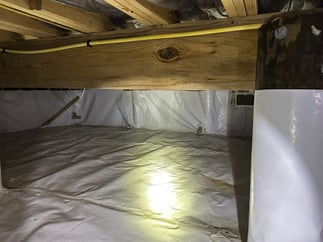
The photo to the left shows a crawlspace with a vapor barrier on the walls and floor.
Some companies will extoll the virtues of a conditioned crawlspace, meaning HVAC vents in the space are open to heat and cool the space. Not a huge fan of conditioned crawl spaces since you are heating and cooling an area that is not habitable.
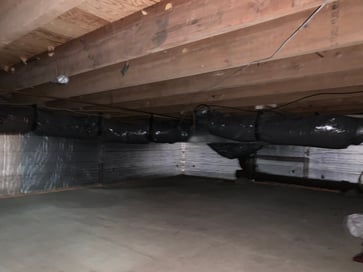
The photo to the right is another crawlspace, which had a concrete floor; no vapor barrier was needed. The walls were insulated with foam board, and the outside vents were sealed. This is a much cheaper approach, but really, it could have been a $100 fix by just sealing the vents. Here is what you do not see but should visualize: that there is zero mold in this space, nor was there ever; the owner told me so as they paid for the insulation on the walls. They are elderly, and they said they were told it was dangerous not to do the insulating - scammed.
Want professional advice on a crawlspace? Call Curren.
